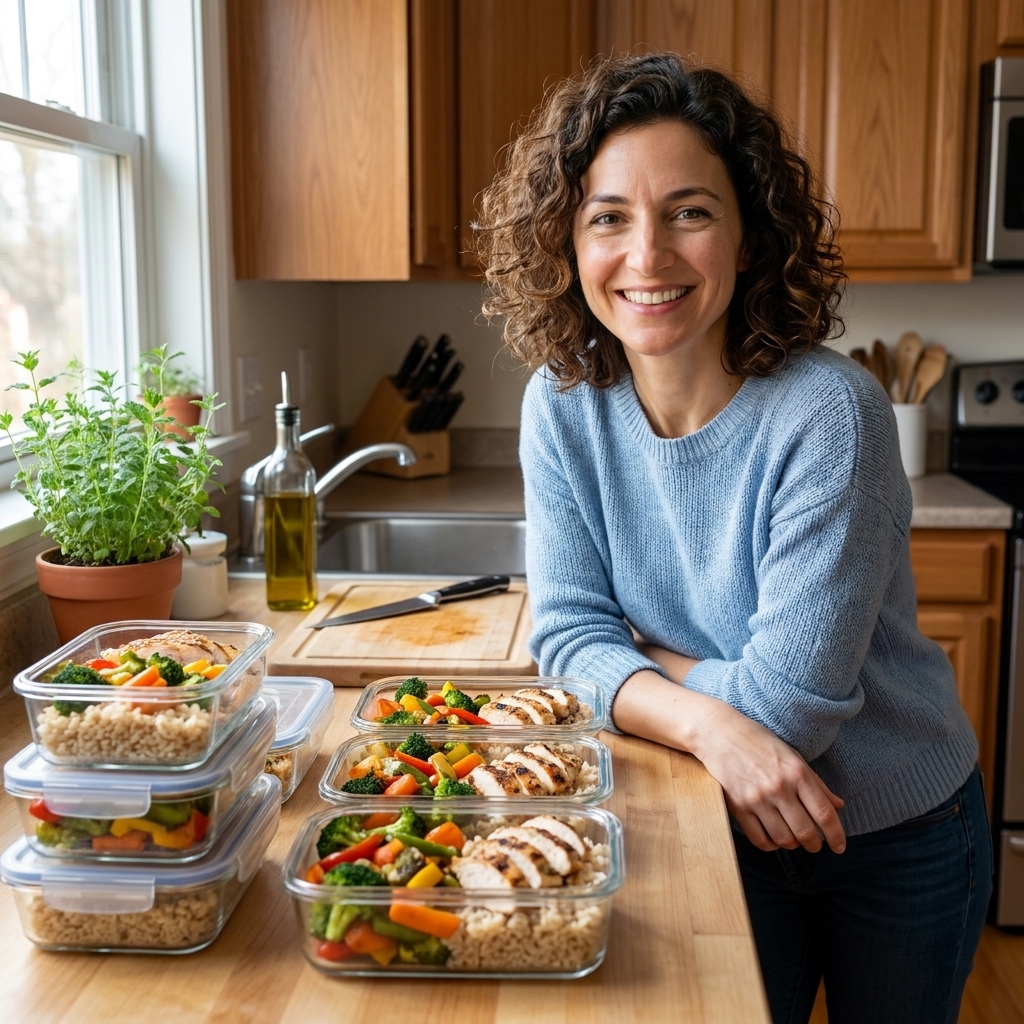
A no-math, no-stress guide to building balanced meals with half veggies, a quarter protein, and a quarter complex carbs, plus smart fats and flavor.
Platepathy
Calculating Macros for Weekly Meal Prep
Learn how to calculate protein, carbs, and fat for your goals, then turn those numbers into a simple weekly meal plan you can actually stick with.

Elena Rossi
Elena Rossi is a Registered Dietitian and meal prep expert who believes that healthy eating shouldn't feel like a second job. Through Platepathy, she translates complex nutrition science into approachable, delicious meal plans designed for real, busy lives.
Published October 18, 2026
Last updated October 18, 2026
When someone says “count your macros,” it can sound like you need a spreadsheet, a food scale, and a personality transplant. I promise you do not. Macros are the three main nutrients people track in most nutrition apps: protein, carbohydrates, and fat. (Yes, other things can contribute calories too, like alcohol, and fiber is a type of carbohydrate with its own benefits.) Learning your personal “macro targets” is like getting a map for meal prep. You can still choose the foods you love, but you are no longer guessing.
As a registered dietitian and a recovering takeout-dependent project manager, I’m a big fan of anything that reduces decision fatigue. Macros can do that, especially when you use them to build a repeatable weekly plan. Around here, that is the Platepathy approach: practical structure, flexible execution, and zero shame spirals.

Macros, explained
Here is the quick, practical breakdown.
- Protein supports muscle repair, immune function, and helps meals feel satisfying.
- Carbohydrates are typically your body’s go-to fuel, especially for your brain and higher-intensity workouts.
- Fat supports hormones, nutrient absorption (hello, vitamins A, D, E, K), and helps meals taste good and keep you full.
Macros are not “good” or “bad.” They are tools. And your best macro balance depends on your goal, preferences, schedule, and health history.
Step 1: Set calories
Macros add up to your total calorie intake. So we start with calories, then assign protein, fat, and carbs.
A realistic calorie range
Unless you are working with a clinician for a medical plan, a range is usually more sustainable than a single perfect number.
- Maintain weight: aim for your current maintenance intake.
- Fat loss: a modest deficit tends to be more livable. Many people do well starting around 250 to 500 calories below maintenance, adjusted for body size and activity.
- Muscle gain: a modest surplus is often enough. Many people start around 150 to 300 calories above maintenance, adjusted for body size and training volume.
If you do not know your maintenance calories, a reputable TDEE calculator can provide a starting estimate. Treat it like a draft, then adjust after 2 to 3 weeks based on your energy, hunger, training, and your weight trend over time.
Platepathy note: If you have a history of disordered eating, tracking can be triggering. You can still use the ideas in this article by building balanced plates and using macro ranges instead of strict targets. And it is always okay to ask for support.
Step 2: Set macros
Once you have a calorie target, we assign macros. There are lots of ways to do this, but beginners do best with a simple method that prioritizes protein first, then fat, then carbs.
Start with protein
Protein is the macro most people under-eat, and it has a big payoff for fullness and body composition.
A beginner-friendly target for many active adults is:
- 0.7 to 1.0 grams of protein per pound of body weight per day (or 1.6 to 2.2 g per kg).
Where to land in that range:
- Closer to 0.7 to 0.8 g/lb if you are newer to strength training, smaller-bodied, or want a less tracking-heavy approach.
- Closer to 0.9 to 1.0 g/lb if you are dieting, lifting consistently, or want more structure.
If you are sedentary, older, pregnant, managing kidney disease, or have other medical considerations, check with your clinician or dietitian before aiming high. The right target is personal.
Set fat next
Fat keeps meals satisfying and supports hormones. A solid starting point for most adults is:
- 20% to 35% of total calories from fat
Or, if you prefer a grams-based guardrail, here is a practical coaching heuristic (not an official guideline):
- 0.3 to 0.5 g of fat per pound (0.7 to 1.1 g/kg) is a common working range.
Fill the rest with carbs
After protein and fat are set, carbohydrates get the remaining calories. Carbs are not the enemy of meal prep. They are often what makes the plan easy, affordable, and energizing.
Macro math you actually need
These are the only numbers to remember:
- Protein: 4 calories per gram
- Carbs: 4 calories per gram
- Fat: 9 calories per gram
A complete example
Let’s pretend your calorie target is 2,000 calories/day.
1) Pick protein
Choose 150 g protein (a common target for many active adults).
- 150 g protein x 4 calories = 600 calories
2) Pick fat
Choose 70 g fat.
- 70 g fat x 9 calories = 630 calories
3) Calculate carbs
Calories left for carbs:
- 2,000 total calories - 600 (protein) - 630 (fat) = 770 calories
Convert to grams:
- 770 ÷ 4 = 192 g carbs
Your starting macros: 150 g protein, 192 g carbs, 70 g fat.
Are those the only “right” macros? Not even close. They are a useful starting point. We refine from there based on real life.
Step 3: Go weekly
This is where macros stop being abstract and start saving you time.
Pick the days you are prepping
Most people do best starting with 3 to 5 days of planned lunches and dinners, plus flexible breakfasts and snacks. Perfection is not required for progress.
Multiply daily macros by planned days
Using our example macros (150P, 192C, 70F):
- 5-day total protein: 150 x 5 = 750 g
- 5-day total carbs: 192 x 5 = 960 g
- 5-day total fat: 70 x 5 = 350 g
You do not need to hit these weekly totals exactly. Think of them like bumpers in a bowling lane.

Step 4: Use anchors
Here is the simplest macro-based meal planning trick I know: pick a few macro anchors you repeat, then rotate flavors.
Pick a protein anchor
- Breakfast: Greek yogurt, eggs, cottage cheese, tofu scramble, protein smoothie
- Lunch: chicken thighs, tuna, lentils, turkey, tempeh
- Dinner: salmon, lean ground beef, chickpeas, shrimp, pork tenderloin
Add a carb base
- Rice, quinoa, pasta, potatoes, tortillas, oats, beans, fruit
Add fat you enjoy
- Olive oil, avocado, nuts, pesto, tahini, cheese, full-fat dairy
Add produce
- Roasted vegetables, salad kits, frozen veg blends, tomatoes and cucumbers, sautéed greens
This protein + carb + fat + produce structure makes it easier to hit macros without building every meal from scratch.
Macro splits
You do not need a complicated schedule. Choose the approach that fits your day.
Option A: Even-ish
Great if you like predictable meals.
- 25% breakfast
- 30% lunch
- 30% dinner
- 15% snack
Option B: Protein-forward
Great if you struggle to get enough protein.
- 30 to 40 g protein at each main meal
- 10 to 25 g protein in snacks (as needed)
For many people, simply aiming for 25 to 40 g protein per meal is the most helpful macro habit to start with.
Goals and macro bias
If you are wondering, “Do my macros need to change based on my goal?” yes, sometimes. Not dramatically, but enough to matter.
- Fat loss: protein tends to matter most for fullness and preserving lean mass. Keeping carbs moderate (not necessarily low) can make adherence easier.
- Strength and muscle gain: protein plus enough carbs to train hard is usually the sweet spot.
- Endurance training: many athletes feel and perform better with higher carbs, especially around longer sessions.
If your workouts feel flat or your recovery is dragging, carbs are often the first lever to revisit.
Numbers vs food quality
You can technically hit macros on protein bars and beige snacks. You can also technically assemble IKEA furniture with a butter knife. Possible does not mean pleasant.
To keep your plan feeling good in your body, aim for these two basics most days:
- Fiber: include at least one high-fiber food at most meals (beans, lentils, berries, oats, chia, whole grains, vegetables). Many adults do well around 25 to 38 g fiber/day, but even moving upward gradually helps.
- Micronutrient coverage: include produce at least twice a day, and more if you can. Frozen counts.
This is also how macro tracking stays grounded in health, not just math.
Meal prep example
Here is what “anchors” can look like in an actual container. Not perfect macros, just close enough to be useful.
Chicken rice bowl
- Protein: 5 to 6 oz cooked chicken thigh or breast
- Carb: 1 cup cooked rice (or potatoes)
- Produce: 2 cups roasted broccoli and peppers
- Fat and flavor: 1 to 2 tablespoons pesto or olive oil based sauce
Depending on your exact portions and ingredients, this often lands roughly in the neighborhood of 35 to 50 g protein, 50 to 75 g carbs, and 10 to 25 g fat. Close enough to build a week around, and easy to adjust by adding or subtracting rice, oil, or protein.
Tracking without obsession
If you want to track macros, use the least intense method that still gives you useful feedback.
Three tracking levels
- Level 1: Macro awareness (no app). Build meals with a protein anchor, include carbs and fats, and check in on hunger and energy.
- Level 2: Track protein only. Many busy parents and professionals thrive here.
- Level 3: Track full macros using an app. Helpful for specific physique or performance goals.
Accuracy tips
- Weigh calorie-dense foods sometimes (oils, nut butters, cheese) since portions vary a lot.
- Use good-enough entries for mixed dishes. Consistency matters more than microscopic accuracy.
- Plan for joy foods. Macros work best when your plan includes the foods you actually want to eat.
Common mistakes
Mistake: Setting protein sky-high
Fix: Pick a target you can hit on normal weekdays. If you miss it by 10 to 20 g, your body is not going to send a complaint letter.
Mistake: Cutting fats too low
Fix: If you feel constantly hungry, cranky, or your meals feel sad, add some fat back in and reassess.
Mistake: Treating carbs like a moral issue
Fix: Choose carbs you enjoy and that support your lifestyle. A budget-friendly pasta night can absolutely fit.
Mistake: Trying to win macros every day
Fix: Aim for weekly consistency. Some days will be higher, some lower. That is normal life.
Make it a plan
If you want macros to feel easier, not harder, build your plan around repeatable components:
- 2 proteins you can cook in bulk (example: shredded chicken, baked tofu)
- 2 carbs that reheat well (example: rice, potatoes)
- 2 big veggie options (example: sheet-pan broccoli, bagged salad)
- 2 sauces for variety (example: salsa verde, peanut sauce)
- 2 snack staples that help you hit protein (example: Greek yogurt, edamame)
Then mix and match. Same groceries, different vibes.

FAQ
Do I need to calculate macros to be healthy?
No. Plenty of people eat well without ever tracking a gram. Macros are useful if you like structure, have specific performance or body composition goals, or feel stuck and want clearer feedback.
How long should I try a macro target before changing it?
Give it 2 to 3 weeks if possible. Look at trends: energy, workout performance, hunger, sleep, and overall adherence. Then adjust one lever at a time (calories or a macro), not everything at once.
What matters most for fat loss: macros or calories?
Calories drive the energy deficit, but macros influence how you feel while doing it. In practice, adequate protein and a sustainable calorie target are the biggest game-changers.
Can I do macros without a food scale?
Yes. A scale can improve accuracy, but you can start with portion estimates (palm of protein, fist of carbs, thumb of fats) and adjust based on results. If a scale makes you obsessive, skip it.
What if my macros look perfect on paper but I cannot stick to them?
Then the macros are not actually perfect. We adjust the plan, not your willpower. Usually this means a slightly higher calorie target, more convenient protein options, or a simpler meal rotation.
Next step
If you want to start today, do this:
- Pick a calorie range that feels realistic.
- Set a protein target you can hit with your current schedule.
- Choose a fat range you enjoy.
- Let carbs fill in the rest.
- Build your weekly meal plan around repeatable protein + carb + fat + produce meals.
And remember the Platepathy rule: the best plan is the one that feeds you and frees up your brain for the rest of your life.