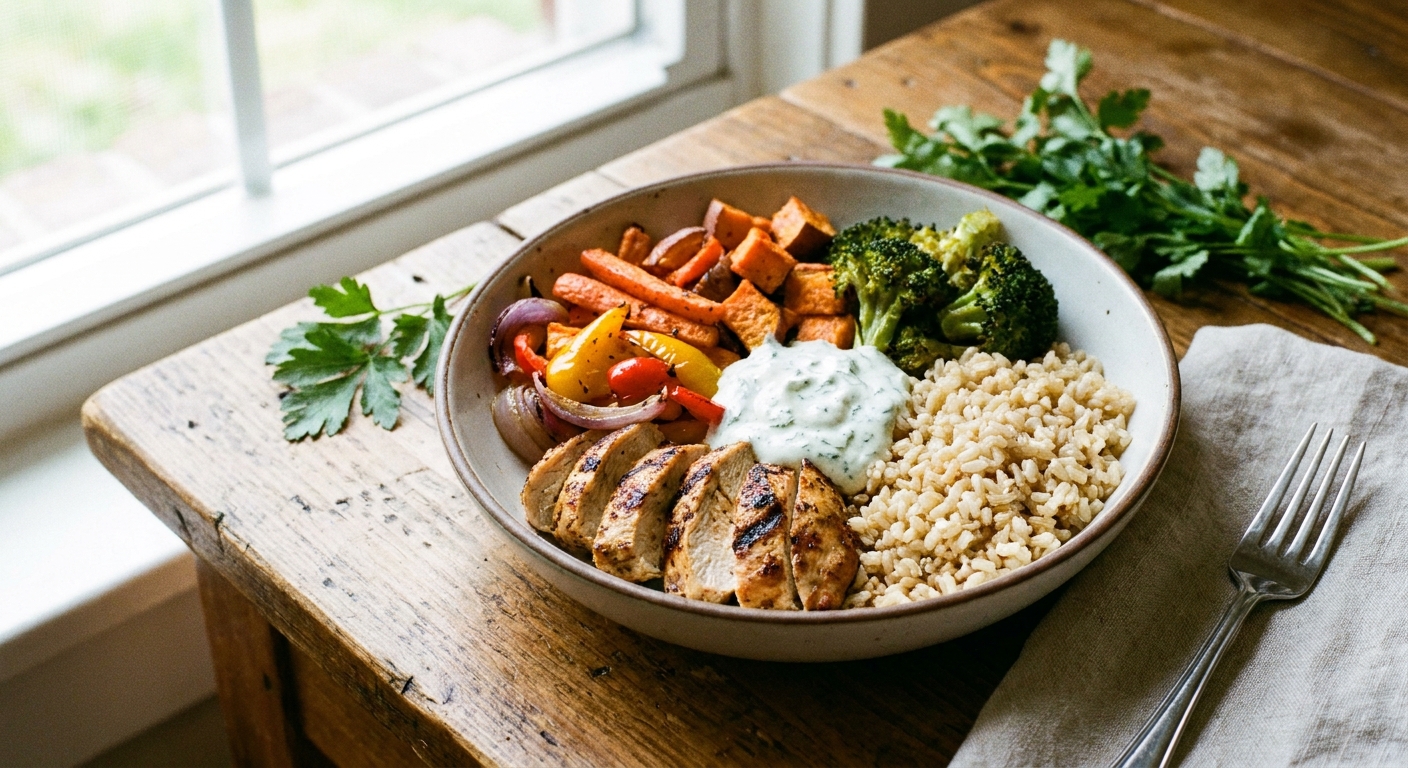
A beginner-friendly, no-stress guide to setting your macro targets and using them to plan breakfasts, lunches, dinners, and snacks for the week.
Platepathy
How Many Calories Should You Eat a Day?
Daily calorie needs depend on your age, body size, and activity, not one “perfect” number. Learn practical ranges, how to split calories across meals, and when to get a personalized target.

Elena Rossi
Elena Rossi writes Platepathy's meal planning guides, translating nutrition research into approachable, delicious meal plans for real, busy lives.
Published November 17, 2026
I used to think “calories” were a scolding word. In my twenties, I was a project manager living on iced coffee, takeout, and whatever diet had the loudest promises that month. I would swing between eating too little (tired, cranky, snacky at 9 PM) and eating whatever was closest when I inevitably crashed.
What finally helped was treating calories like a budgeting tool, not a moral grade. A starting point. A way to make sure my body gets enough energy to think clearly, move comfortably, and still have patience for bedtime stories.
So let’s answer the big question with the honesty it deserves: there is no single magic number. But there are very usable ranges, and you can absolutely turn them into meal targets for a week of real-life eating.
What a calorie target means
Calories are simply a measure of energy. Your body uses energy to keep you alive (breathing, circulation, brain function) and to power everything you do on top of that (walking, lifting, working, parenting, training, fidgeting, digesting).
Most calorie targets you see online are meant to estimate your total daily energy expenditure (often shortened to TDEE). This is the intake where many people maintain weight, give or take normal fluctuations.
From there:
- To maintain: you generally eat around your TDEE.
- To lose weight: you generally eat below your TDEE for a sustained period.
- To gain weight: you generally eat above your TDEE for a sustained period.
Platepathy note: “Generally” matters. Hormones, sleep, medications, stress, recovery, and muscle mass can all change how your body uses energy. Think: starting estimate, then adjust with empathy and data.
Why calorie needs change
Age
As we age, calorie needs often drift down. Part of that is physiology (resting metabolic rate can decline a bit over time, largely influenced by lean mass). Part of it is behavior (many of us move less without meaning to). The good news is you can counter a lot of that with strength training, adequate protein, and keeping daily movement in the mix.
Body size and body composition
Larger bodies typically require more energy to maintain basic functions and movement. People with more muscle mass also tend to burn more calories at rest than people with less muscle mass, even at the same scale weight.
Activity level (including “background” movement)
Formal workouts matter, but so does everything else: walking meetings, commuting, chasing toddlers, standing for work, weekend house projects. This “background movement” is a huge reason two people of the same height and weight can have very different needs.

Daily calorie ranges to use
Because individual needs vary, ranges are more helpful than one number. The ranges below reflect rough norms many adults fall into, based on widely used population-level estimates (like those used in U.S. nutrition guidance and energy requirement frameworks). Some people will land outside these ranges, and that can still be completely normal.
Adult women: common maintenance ranges
- Less active: about 1,600 to 2,000 calories/day
- Moderately active: about 1,800 to 2,200 calories/day
- Very active: about 2,000 to 2,400+ calories/day
Adult men: common maintenance ranges
- Less active: about 2,000 to 2,400 calories/day
- Moderately active: about 2,200 to 2,600 calories/day
- Very active: about 2,600 to 3,000+ calories/day
What “less active” usually looks like: mostly seated day, daily steps on the low side, little intentional exercise.
What “moderately active” usually looks like: you walk most days and do 3 to 5 workouts per week, or you have an active job.
What “very active” usually looks like: you train hard most days, have high step counts, or do both (think: distance training, manual labor plus training, double sessions).
If you want a fast starting point inside these ranges, pick a number that matches your life right now, not your “ideal week.” Most of us live in the right-now.
Estimate your maintenance
If you like a bit more personalization, here’s a practical method that stays within the “no obsession required” zone.
Option A: Use a calculator
A reputable TDEE calculator can give you a maintenance estimate based on height, weight, age, sex, and activity. Treat the result as a starting hypothesis.
Option B: Use your own data
- Pick a reasonable intake guess based on the ranges above.
- Eat around that amount for 2 to 3 weeks (consistency matters more than perfection).
- Track your trend, not day-to-day noise: body weight (if relevant to your goals), hunger, energy, training performance, sleep, and mood.
- If you weigh yourself, use consistent conditions (same time of day, similar clothing) and look at weekly averages or a rolling trend line, not a single weigh-in.
- Adjust by about 100 to 200 calories per day if you are consistently drifting up or down and that is not your goal. Smaller bodies may need smaller changes. Larger bodies and very active people sometimes need bigger ones.
That small adjustment is often enough. You do not need dramatic swings to learn what your body needs.
Also worth saying out loud: calorie counting is imperfect. Labels can be off, restaurant meals vary, and tracking apps are just estimates. That is another reason trends beat perfection.
Turn calories into meals
Once you have a daily calorie range or target, the next question is the one I hear from busy families all the time: “Okay, but what does that look like on a Tuesday?”
Below are simple splits you can use for meal planning. They are not rules. They are training wheels.
Split 1: Classic
- Breakfast: 25%
- Lunch: 30%
- Dinner: 35%
- Snack: 10%
Split 2: Snack-friendly
- Breakfast: 25%
- Lunch: 30%
- Dinner: 30%
- Snack 1: 7.5%
- Snack 2: 7.5%
Split 3: Bigger dinner
- Breakfast: 20%
- Lunch: 30%
- Dinner: 40%
- Snack: 10%
If you get ravenous at 4 PM every day, that is useful information. Shift some calories earlier. If dinner is your family anchor meal, it is fine for dinner to be the largest.
Meal target examples
To make this concrete, here are a few daily totals split using the classic approach (25% breakfast, 30% lunch, 35% dinner, 10% snack).
| Daily calories | Breakfast (25%) | Lunch (30%) | Dinner (35%) | Snack (10%) |
|---|---|---|---|---|
| 1,600 | 400 | 480 | 560 | 160 |
| 1,800 | 450 | 540 | 630 | 180 |
| 2,000 | 500 | 600 | 700 | 200 |
| 2,200 | 550 | 660 | 770 | 220 |
| 2,500 | 625 | 750 | 875 | 250 |
This is meal planning gold because you can now look at a recipe and think, “Is this a 600-calorie lunch bowl or an 800-calorie dinner?” without spiraling into perfectionism.
Calories are not the whole plan
Once you have a calorie range that fits your life, then we think about how to build meals that keep you full and satisfied.
What matters next
- Protein: helps with fullness, muscle repair, and steady energy.
- Carbs: often the most accessible, primary fuel for daily life and especially higher-intensity training, plus a big source of fiber when you choose whole-food carbs often.
- Fats: supports hormones, absorption of fat-soluble vitamins, and makes food taste good (which helps consistency).
- Fiber and fluids: digestion, fullness, heart health, and “I cannot figure out why I am hungry” moments.
If you ever feel like you are “hitting calories” but still not satisfied, the issue is often meal composition: not enough protein, fiber, volume, or dietary fat to keep you comfortably full.
When you need personal guidance
Some seasons of life deserve more than a generic range. Please consider a personalized plan (with a registered dietitian, and medical care when appropriate) if any of the below apply:
- Pregnancy or breastfeeding (needs change by trimester and postpartum, and appetite can be unpredictable)
- History of disordered eating or calorie tracking feels mentally sticky
- Diabetes, thyroid disease, PCOS, GI conditions, kidney disease, or other medical conditions that affect intake and metabolism
- Medications that influence appetite, weight, or nutrient needs
- Heavy training (endurance plans, CrossFit-style high volume, two-a-days, competitive sport)
- Teens (growth changes needs quickly, and restriction can backfire)
And if your body is sending loud signals like fatigue, dizziness, hair loss, constant coldness, missed periods, or poor workout recovery, that is not a willpower problem. It is a “let’s reassess” moment.
Gentle guidance for goals
Plate empathy means we can talk about weight goals without punishment vibes.
If your goal is weight loss
A modest deficit is typically more sustainable than an aggressive one. Many people do well adjusting by about 250 to 500 calories per day, but smaller bodies may need smaller changes and larger bodies or very active people may need a different approach. Your best deficit is the one you can maintain without feeling miserable, obsessive, or constantly hungry.
If your goal is weight gain
A modest surplus often works best, especially if you are strength training. Think roughly 150 to 300 calories per day above maintenance as a common starting point, then adjust based on your trend and training performance. Again, some bodies will need smaller or larger steps.
If your goal is maintenance
Maintenance is an underrated goal. Eating enough to support stable mood, fewer cravings, and consistent dinners at home is a health win, even if the scale does not move.
FAQ
Is 1,200 calories a day enough?
For most adults, 1,200 calories is very low and difficult to meet nutrient needs with, especially for protein, fiber, and essential fats. It can increase fatigue and may raise the risk of rebound overeating for some people. If you were advised to eat this little by a professional for a specific reason, make sure you have appropriate medical and nutrition support.
Is 2,000 calories a day normal?
It is a common reference point on nutrition labels and it can be a reasonable maintenance amount for some people. But “normal” depends on your body size, muscle mass, and activity. Plenty of adults maintain above or below 2,000.
How do I know if I am eating too little?
Common signs include persistent hunger, low energy, irritability, poor sleep, feeling cold often, trouble concentrating, constant thoughts about food, stalled workout performance, or feeling out of control around snacks at night.
Do I need to track calories?
No. Tracking can help some people learn portions and patterns, but it is not required for success. Many people do better using a consistent meal structure and a few anchor meals they love, then adjusting portions based on hunger, energy, and progress.
What is the simplest way to apply this to a weekly plan?
Pick a calorie range, then pick meal targets using a split that fits your day. Build a short list of repeatable breakfasts and lunches that land near those targets, and rotate dinners you enjoy. Consistency comes from making weekdays easier, not from chasing perfect math.
The Platepathy takeaway
Your daily calorie needs are not a test you either pass or fail. They are information.
Start with a realistic range based on your age, body size, and activity. Split it into meals that fit your actual schedule. Then build satisfying plates with protein, fiber-rich carbs, colorful plants, and enough fat to make it taste like something you want to eat again.
If you want one gentle next step: choose a daily range, choose a meal split, and plan just two breakfasts, two lunches, and three dinners for the week. That is often all it takes to go from “What are we eating?” to “We have a plan.”